
How much does Claude Code actually cost per session?
Anthropic says the average is $6 per developer per day. That number hides a lot. Here's what a simple bug fix, a complex feature, and an autonomous computer control session actually cost at current API prices, and where token bills quietly get large.
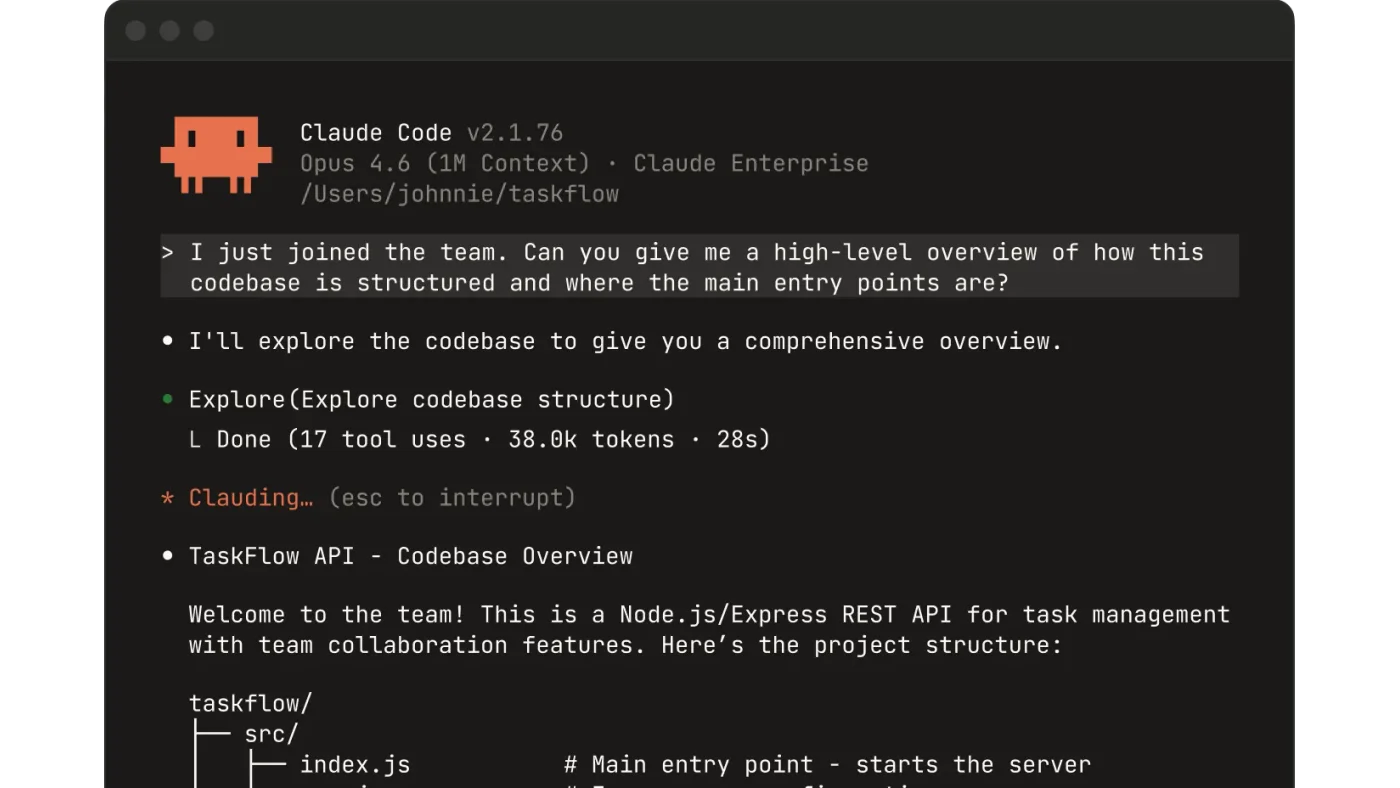
Image source: Anthropic
What Anthropic's own numbers say
Anthropic publishes a cost guide for Claude Code in their docs. The headline number: $6 per developer per day, with 90% of developers staying under $12/day. Monthly, that works out to $100-200 per developer.
Those figures assume Sonnet 4.6 as the default model, which is what Claude Code uses unless you change it with /model. The caveat Anthropic adds is "large variance depending on how many instances users are running and whether they're using it in automation." That caveat does a lot of work. Developers running agent teams or overnight automation report costs well above the $12/day ceiling.
On HackerNews, one commenter calculated closer to $500/month for a developer who maxes out their weekly rate limits every week. Others mentioned burning "hundreds of dollars a day" on agentic workloads. The $6/day figure is accurate for moderate interactive use. It just doesn't describe what autonomous agents do when left to run.
Current pricing for each model
Claude Code lets you switch models mid-session with /model. Cache pricing is where a lot of real-world savings come from, especially on tasks that re-read the same files repeatedly.
| Model | Input / 1M | Output / 1M | Cache Read / 1M | Cache Write / 1M |
|---|---|---|---|---|
| Sonnet 4.6 (default) | $3.00 | $15.00 | $0.30 | $3.75 |
| Opus 4.6 | $5.00 | $25.00 | $0.50 | $6.25 |
| Haiku 4.5 | $1.00 | $5.00 | $0.10 | $1.25 |
Prices from Anthropic pricing, retrieved March 28, 2026. Cache writes have a 5-minute TTL by default; 1-hour TTL is available at 2x the base input rate. Check our pricing page for the full model comparison.
What specific sessions actually cost
The thing that catches people off guard is how context accumulates. A normal chat sends a few hundred tokens. Claude Code sends your full conversation history, all tool call outputs, and any file contents on every single request. Each turn is more expensive than the last. A 30-message session can easily hit 150K input tokens even on a simple task.
Math (bug fix): (18K × $3/M) + (3K × $15/M) = $0.054 + $0.045 = $0.099. Estimates based on typical session patterns using Sonnet 4.6. Your actual numbers depend on file sizes, conversation length, and tool call frequency. Use the cost calculator for a custom estimate.
Computer control adds overhead on every action
On March 24, 2026, Anthropic launched "safer auto mode" for Claude Code - autonomous computer control that lets Claude operate your Mac without per-action approval prompts. The feature is genuinely useful. It is also a new cost layer that compounds quickly.
Auto mode works by running a separate classifier call on Sonnet 4.6 before each action Claude wants to take. Shell commands, file writes, network requests - each one gets screened. That classifier call sends a chunk of your conversation context plus the pending action to a second model. The longer your session context, the more expensive each individual check becomes.
Anthropic's docs also note that agent teams use approximately 7x more tokens than standard sessions, because each subagent maintains its own full context window. Auto mode requires Team plan or above and only works with Sonnet 4.6 or Opus 4.6 - you can't switch to Haiku to reduce costs here.
Flat-rate alternatives and where they break even
At Anthropic's stated average, pay-per-token API billing is noticeably more expensive than flat-rate coding tools. The tradeoff is that flat-rate tools have usage ceilings; the API doesn't.
| Option | Monthly cost | Usage limits |
|---|---|---|
| GitHub Copilot Pro | $10 | 300 premium requests/month |
| GitHub Copilot Business | $19/seat | 300 premium requests/seat |
| Cursor Pro | $20 | Extended limits, frontier models |
| Windsurf Pro | $20 | Standard usage, overflow at API price |
| Claude Pro (includes Claude Code) | $20 | Moderate usage |
| Claude Max (5x) | $100 | Heavy usage |
| Claude Max (20x) | $200 | Power users |
| Claude Code API - average ($6/day x 22 days) | ~$132 | No ceiling |
| Claude Code API - 90th percentile ($12/day) | ~$264 | No ceiling |
At average API usage, you're spending about $112/month more than a Cursor Pro subscription - roughly a year of Cursor Pro for every three months of API fees. Claude Pro at $20/month includes Claude Code access and is the sensible entry point for most developers. The API makes sense if you're building on top of it programmatically, running CI pipelines, or doing light enough use that you'd never fill a subscription anyway.
Practical ways to reduce the bill
Most cost-saving advice for Claude Code is either obvious or not worth the friction. These four actually move the number.
Once a session has hundreds of messages, every subsequent request sends all of it. The /compact command replaces conversation history with a structured summary. In a long session, this cuts input costs by 50-70% on everything that follows. You can customize it: /compact Focus on modified files and current task.
Context from a previous task gets sent on every subsequent request even when it's irrelevant. Finishing a bug fix and moving to a different part of the codebase? Run /clear first. It's the simplest habit with an immediate difference.
Haiku 4.5 costs $1/M input vs $3/M for Sonnet 4.6. For subagents doing research, file reads, or simple extraction, Sonnet is overkill. Set model: haiku in subagent configuration. On agent team sessions - the ones that already burn 7x normal tokens - this can cut subagent costs by 60-70%.
CLAUDE.md loads into every session and stays in context for every API call. Anthropic's docs explicitly recommend staying under 500 lines. Every unnecessary line charges you on every request. Move task-specific instructions to skills that load only when needed.
When pay-per-token actually wins
API billing makes real sense for light or occasional use (under ~$20/month where it undercuts any subscription), CI/CD pipelines needing exact per-run cost tracking, and teams already on the Anthropic API where Claude Code is just an incremental addition. Those are narrower cases than most developers expect.
For daily active development, $132/month is the honest number. That buys six months of Cursor Pro or six and a half GitHub Copilot Business seats. If you don't need raw API access, Claude Pro at $20/month includes Claude Code and is what most developers should probably be using.
The psychological dimension is real and underappreciated. One developer on HackerNews put it clearly: on a flat-rate plan, a wasted context window is an annoyance. On the API, the same mistake is a $30 invoice line. That changes how freely you let the model run - which is exactly what autonomous agents need.
For heavy agentic use - computer control running for hours, agent teams burning 7x baseline tokens - there is no ceiling. The March 24 computer control launch makes those workloads meaningfully more expensive than standard interactive sessions. Run the math on our cost calculator before committing to API billing for anything agentic.