
Gemini 4 Carbon tops the index on Opus 5.5's $4/$20 card and costs 23% less per task. Drop one point and Opus or Astra is cheaper, and you can't call Carbon yet.
Google priced Gemini 4 Carbon on Wednesday the way it priced Argon a month ago: $2 in and $10 out to start, $4 and $20 later. That later card is Claude Opus 5.5's, line for line. So the question is not which rate card is cheaper. It's which model finishes the job on fewer tokens, and whether you can call it at all.

Image source: Google
If you only came for the number: Carbon is the highest-scoring model on Artificial Analysis right now, and per task it undercuts Opus 5.5 at max effort by 23% on the same rate card. It is not the cheapest way to get a 57, and nobody outside Google's cyber program can buy it today.
Two prices, one of them with no end date
Everything Google has said about Carbon's price is in four lines of the launch post. There is no Carbon row on the Gemini API pricing page yet, no model ID and no batch rate. The cached rates below are our arithmetic from Google's "95% off input".
| Model | Input | Cached | Output | Until |
|---|---|---|---|---|
| Gemini 4 Carbon, intro | $2.00 | $0.10 | $10.00 | not stated |
| Gemini 4 Carbon, after | $4.00 | $0.20 | $20.00 | - |
| Gemini 4 Argon | $2.00 | $0.10 | $10.00 | Nov 30 |
| Gemini 4 Argon, from Dec 1 | $4.00 | $0.20 | $20.00 | - |
| Claude Opus 5.5 | $4.00 | $0.20 | $20.00 | - |
| GPT-6.1 Sol | $2.00 | $0.10 | $10.00 | - |
Per million tokens, standard tier. Carbon from Google's launch post, Argon from the Gemini API pricing page, Opus 5.5 and Sol from Anthropic's and OpenAI's pricing pages, all read October 31, 2026. Opus also charges $5 per million to write its 5-minute cache; Gemini 4 has no write fee on Argon's implicit caching.
Argon's intro price also launched without an end date. Within a week of GA the pricing page gave it one: November 30. We expect Carbon to get the same treatment, and we'd budget at $4/$20 from day one. Any estimate built on $2/$10 has an unknown expiry date baked into it.
What a finished task costs
Matching rate cards tell you nothing about the bill when one model thinks twice as long. Artificial Analysis publishes a cost per task on its Intelligence Index v5.0, so we sorted the models people will actually weigh against Carbon by that. Score before the name, dollars on the bar.
- 55 GPT-6.1 Sol, max$1.27
- 59 Carbon, intro $2/$10$3.88
- 57 Opus 5.5, xhigh$6.05
- 57 GPT-6 Astra, max$6.24
- 50 Argon, from Dec 1$7.68
- 59 Carbon, $4/$20$7.76
- 58 Opus 5.5, max$10.04
Artificial Analysis Intelligence Index v5.0, read October 31, 2026. AA prices both Gemini 4 models at $4/$20 and tests them at high only. The Carbon intro row is AA's figure halved, which is exact because every line of the card halves. v5.0 scores don't line up with the v4 numbers in our older posts.
At the price Carbon will settle on, it beats Opus 5.5 max by a point and costs $7.76 a task to Opus's $10.04. Opus wrote 220 million output tokens across the index and Carbon 200 million, so part of that gap is just fewer tokens at the same $20.
Drop one point and the order flips. Opus 5.5 at xhigh and GPT-6 Astra at max both score 57, for $6.05 and $6.24 a task, 20 to 22% under Carbon. Drop four points and GPT-6.1 Sol at max does 55 for $1.27, a sixth of Carbon's standard cost and a third of its intro cost. Carbon has only been tested at one effort setting, so there is no cheaper Carbon on the chart yet.
The Argon comparison is the odd one. Same card, nearly the same cost per task ($7.68), nine points lower. Carbon writes almost twice Argon's output tokens (200M to 110M) and still costs the same, which means Argon is spending its money on the input side. Either way, once Carbon is in the API we see no reason to stay on Argon past December 1.
Google's own table
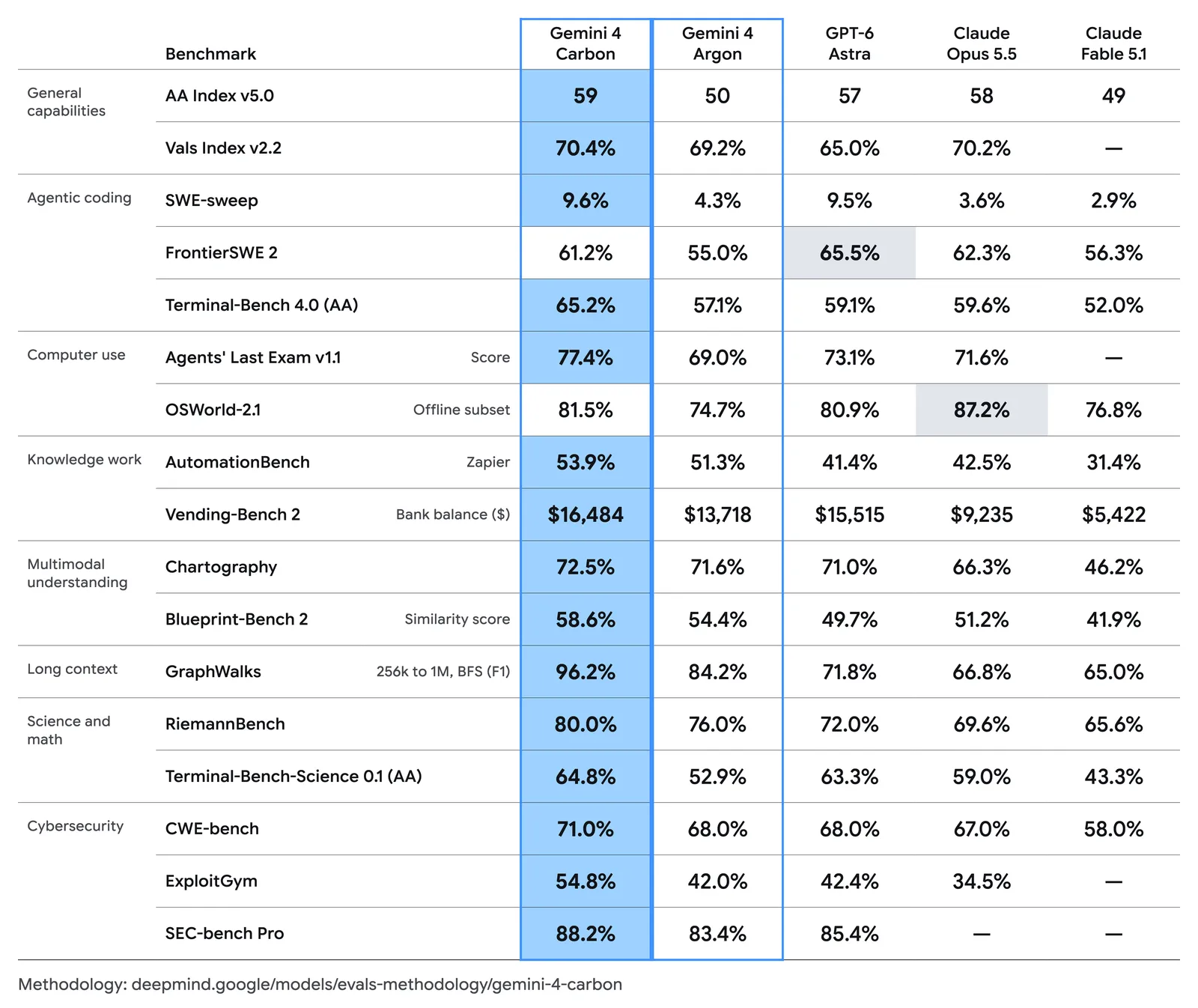
Image source: Google. Vendor-reported, with methodology at deepmind.google.
Carbon wins 15 of 17 rows, which is what launch tables are for. The two it loses are worth a look if you write code or drive a desktop. GPT-6 Astra leads FrontierSWE 2 at 65.5% to Carbon's 61.2%, and Opus 5.5 leads OSWorld-2.1 at 87.2% to 81.5%. Astra costs $10/$50 per million, so winning one coding row doesn't make it the cheaper coding model.
The biggest gap is long context. On GraphWalks between 256K and 1M tokens Carbon scores 96.2% to Opus 5.5's 66.8%. Opus 5.5 and Argon both bill the full 1M window at one rate. Google hasn't said whether Carbon does, but if it follows Argon and you already pay to send long prompts, this is the row that might change which model you use.
Our agent month, priced three ways
Same workload as our Terra post: 1 billion input tokens a month, 85% of them cache hits, and 50 million output. We assume Carbon caches like Argon, implicitly and with no write fee. Google hasn't said.
| Model | 150M uncached | 850M cached | 50M out | Month |
|---|---|---|---|---|
| Gemini 4 Carbon, intro | $300 | $85 | $500 | $885 |
| GPT-6.1 Sol | $375 | $85 | $500 | $960 |
| Gemini 4 Carbon, $4/$20 | $600 | $170 | $1,000 | $1,770 |
| Claude Opus 5.5 | $750 | $170 | $1,000 | $1,920 |
Sol's uncached input is billed as 30-minute cache writes at $2.50; Opus's as 5-minute writes at $5. No batch, no long-context surcharges.
On paper Carbon at full price comes in $150 under Opus, and the whole difference is Anthropic's cache-write premium. That assumes both models write the same 50 million output tokens. They won't. On the index Carbon wrote 9% fewer than Opus max and nearly twice Argon's, so measure your own token counts before trusting any monthly figure, ours included.
When you can actually call it
Right now Carbon goes to a subset of cyber defenders, then to more partners through Google's Fairwind Program. Developers get it "as soon as possible", with no date. Argon went through the same steps, announced September 30 and on the API October 13. If Carbon keeps that pace it lands around November 10. That is our guess, not Google's.
Two numbers from AA's page will matter more than the price for interactive use. Carbon takes 118.6 seconds to its first token and then streams at 84.6 tokens a second. That is slow, but Opus 5.5 at max takes 729.6 seconds. Neither belongs behind a chat box at these settings.
Until it ships, we list Carbon on its model page as partner-only and keep it out of the default pricing views, because a price you can't pay isn't much use in a comparison. If you're choosing between Argon and Opus 5.5 for December, run both through the calculator at $4/$20. Then plan to test Carbon the week it arrives.
Sources
- Google: Introducing Gemini 4 Carbon - pricing, access, benchmark table, hero image
- Gemini API pricing - Argon's dated rates, no Carbon row as of October 31
- Artificial Analysis: Gemini 4 Carbon and leaderboard - Index v5.0 scores, cost per task, output tokens, speed and TTFT
- Anthropic pricing and OpenAI pricing - Opus 5.5, GPT-6.1 Sol and GPT-6 Astra rates