
Gemini 4 Hydrogen scores 51 for $1.87 a task. GPT-6.1 Terra scores 51 for $0.96, and it's on Google's own launch chart.
Hydrogen is the model 3.8 Flash users should move to, and it's a big upgrade for them. It just isn't the cheapest way to a 51.
Image source: Google
Google released Gemini 4 Hydrogen on November 12. Google pitches it as the upgrade for teams on 3.8 Flash, the ID is gemini-4-hydrogen, and it costs $1.50 per million input tokens and $7.50 per million output. Google says it scores 51 on the Artificial Analysis Intelligence Index at its default high effort, one point over Gemini 4 Argon.
Google also published this chart in the launch post. Look at the dark line on the left.
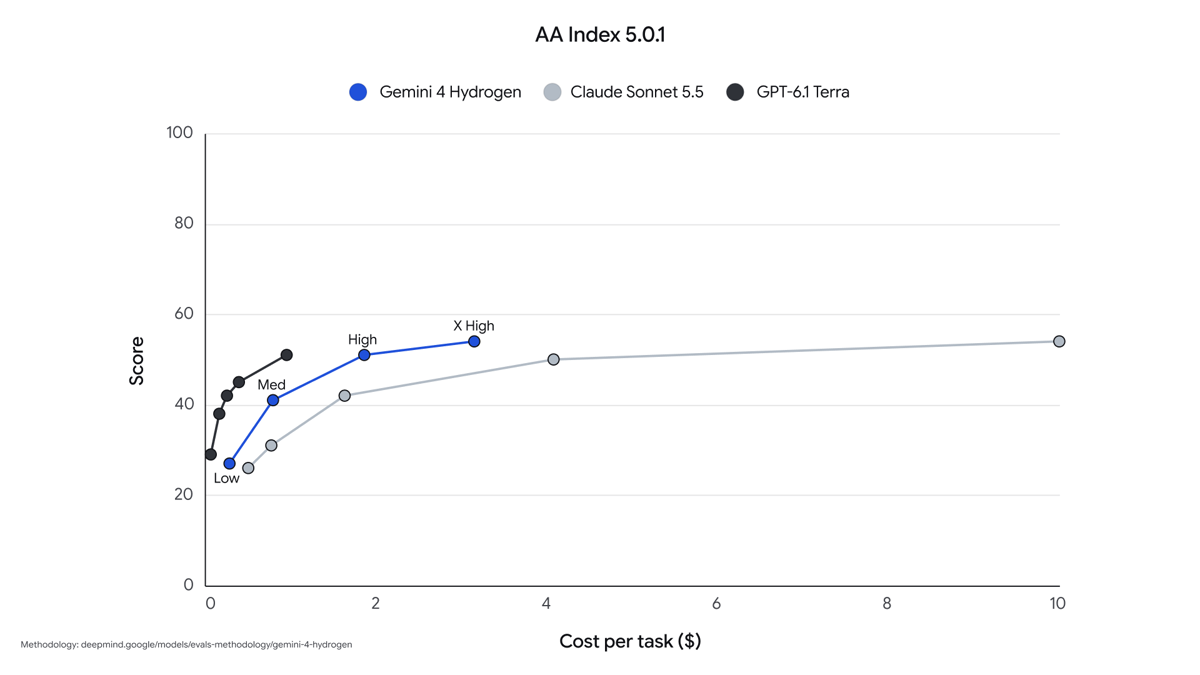
Chart from Google's launch post, AA Index v5.0.1.
That's GPT-6.1 Terra. Its top point sits at the same score as Hydrogen's High point, about a dollar further left. Google drew a chart where a competitor reaches its headline number for half the money, and put it in the announcement.
The rate card
| Per 1M tokens | Input | Cached | Output |
|---|---|---|---|
| Hydrogen Standard | $1.50 | $0.075 | $7.50 |
| Hydrogen Batch / Flex | $0.75 | $0.0375 | $3.75 |
| Hydrogen Priority | $2.70 | $0.135 | $13.50 |
| 3.8 Flash until Dec 31 | $0.75 | $0.075 | $3.75 |
| 3.8 Flash from Jan 1 | $1.50 | $0.15 | $7.50 |
| Argon until Nov 30 | $2.00 | $0.10 | $10.00 |
| Argon from Dec 1 | $4.00 | $0.20 | $20.00 |
| GPT-6.1 Terra (to 272K) | $1.00 | $0.05 | $5.00 |
From Google's pricing page, November 13, 2026. Output includes thinking tokens. Terra's card is from our Terra post.
Hydrogen's input and output rates are exactly what 3.8 Flash charges from January 1, 2027, when its introductory price runs out. Its cached rate is half of 3.8 Flash's January one, $0.075 against $0.15. Google is pricing the new model at the old one's full rate and calling the jump an upgrade, which on a per-task basis it is.
There's no long-context step. The price is the same at 5K tokens and at 1M. Past 272K, Terra bills the whole request at $2 in, $0.10 cached and $7.50 out, which is Hydrogen's output rate. If your prompts run long, that closes some of the gap below.
Caching is implicit only. You get the 95% discount on repeated prefixes automatically and pay no storage fee, but you can't create an explicit cache. If your 3.8 Flash code pins a cache and pays $0.50 per million tokens an hour for it, that code path won't carry over.
Ten configurations, sorted by price
| Model and effort | AA score | $ per task | Minutes |
|---|---|---|---|
| Gemini 4 Hydrogen low | 27 | $0.29 | 1.3 |
| Claude Sonnet 5.5 medium | 31 | $0.78 | 3.8 |
| Gemini 4 Hydrogen medium | 41 | $0.80 | 3.7 |
| GPT-6.1 Terra max | 51 | $0.96 | 14.6 |
| Claude Sonnet 5.5 high | 42 | $1.64 | 6.9 |
| Gemini 4 Hydrogen high (default) | 51 | $1.87 | 7.9 |
| Gemini 4 Hydrogen xhigh | 54 | $3.16 | 13.7 |
| Claude Fable 5.2 medium | 56 | $3.80 | 7.5 |
| Gemini 4 Argon high | 50 | $4.97 | 30.0 |
| Gemini 3.8 Flash high | 31 | $7.77 | 14.7 |
Artificial Analysis Intelligence Index v5.0.1, each model's page read November 13, 2026 (Hydrogen high, xhigh, Terra, 3.8 Flash). Argon is costed at its card before December 1.
Against Claude Sonnet 5.5, Hydrogen wins at every matched effort. On medium it scores 41 to Sonnet's 31 for two cents more. On high it's 51 to 42 for $0.23 more. That's the comparison Google led with, and it holds.
Terra is the problem. Terra on max scores 51 for $0.96, and Hydrogen on high scores 51 for $1.87, 1.95x as much. Run 10,000 index-sized tasks a month and that's $9,600 against $18,700.
What you get for the extra money is time. Hydrogen high finishes a task in 7.9 minutes and Terra max takes 14.6, because Terra streams 68 tokens a second to Hydrogen's 179. For an agent a user is watching, that's worth paying for. For an overnight batch job it isn't, and there both have a 50% batch tier, so the ratio stays put.
Why a task costs $1.87
AA doesn't publish a dollar split for Hydrogen, but it does count output tokens: 110M at high across the index. The index has about 1,360 tasks (we derive that from AA's per-task token counts on other models), so that's roughly 81K output tokens, or $0.61, per task. The other $1.26, about two thirds, is input.
Same arithmetic on Terra gives about 73K output tokens and $0.37, leaving $0.60 of input. Hydrogen writes only a little more than Terra. Its input bill is twice as big because its input rate is 1.5x Terra's and its cached rate is 1.5x too ($0.075 vs $0.05). Agent tasks reread their context every turn, so the cached rate is the line that matters most.
xhigh is different. It wrote 304M output tokens, 4.2x AA's median, and output becomes about half the bill. Three more points for 69% more money, and Claude Fable 5.2 on medium scores 56 for $0.64 above that. If you need more than 51, we'd skip Hydrogen xhigh and look at Fable medium.
Coming from 3.8 Flash, it's an easy call
On AA, 3.8 Flash at high scores 31 and costs $7.77 a task. Hydrogen at high scores 51 and costs $1.87, at twice the per-token price. That looks wrong, so we checked. 3.8 Flash wrote 126M output tokens, about $0.35 a task. Nearly all the rest, around $7.40, is input. Hydrogen finishes a task in about half the time (7.9 minutes to 14.7) and, by the look of it, spends far fewer turns rereading context. AA doesn't break down 3.8 Flash's input, so take the reason as our reading, not a fact.
The total is AA's, though, and so is the score. And on January 1, 3.8 Flash's rates double, so its per-task cost should roughly double with them. Google hasn't set a shutdown date for 3.8 Flash on its deprecations page, but unless you depend on explicit caching, there is little left to keep it for.
Argon is in a similar spot. It scores 50 for $4.97 at today's card, and its card doubles on December 1. Hydrogen high beats it by a point for 38% of today's cost. Our Argon post covers the December change.
Google's benchmark table
| Benchmark | Hydrogen | Sonnet 5.5 | GPT-6.1 Terra |
|---|---|---|---|
| Terminal-Bench 4.1 | 57.0% | 63.9% | - |
| OSWorld-2.1 | 77.6% | 83.9% | 74.2% |
| AutomationBench-AA | 76.1% | 71.8% | 60.2% |
| Agents' Last Exam v1.1 | 71.6% | 60.4% | 69.8% |
| HLE-Diamond | 58.8% | 53.3% | 47.3% |
| Vending-Bench 2 | $14,549 | $11,165 | $9,107 |
Vendor-reported, from the Gemini 4 Hydrogen model card. Selected rows.
Sonnet still wins the two computer-use and terminal rows. Hydrogen wins the long-horizon agent ones, and Terra trails on most of them. Google ran these, and the Terra comparison is the one we'd want to rerun ourselves: on AA's own index the two tie.
Small print worth knowing
"Up to 1 million output tokens" needs a footnote. The model doc caps synchronous responses at 65,536 tokens. The 1M figure is Google's background long-decode mode.
The free tier covers Hydrogen but not search grounding. On paid tiers you get 5,000 grounded requests a month shared across Gemini 3 and later, then $14 per 1,000. A 20K-in, 2K-out request costs about $0.045 on Hydrogen, and one grounded call adds $0.014 to it.
Google's post lists AI Studio, the Gemini API, Android Studio, Antigravity, Gemini Enterprise, the Gemini app, Search and Sheets. It doesn't mention Vertex AI, and we couldn't find a Vertex price yet.
Our take
If you're on 3.8 Flash or Argon, switch to Hydrogen this month. You'll get a better model and a smaller bill, before either of their prices goes up.
If you're picking fresh, test Terra first. It reaches the same AA score for about half the money, and it only loses if speed is part of the product or your prompts often pass 272K. Hydrogen is the faster option, not the cheaper one.
Hydrogen has its own model page. Compare it with Terra and Sonnet 5.5 on the pricing table, or put your own token counts into the calculator. For the January change, see our 3.8 Flash post.
Sources
- Google: Introducing Gemini 4 Hydrogen - release date, price, thinking levels, AA chart, availability
- Gemini API pricing - Hydrogen, 3.8 Flash and Argon rates, batch, priority, caching, grounding
- Gemini 4 Hydrogen model doc and model card - ID, context, output limits, features, benchmark table
- Artificial Analysis model pages - index scores, cost per task, output tokens, speed and time for every row in the table
- Gemini API deprecations - release dates and shutdown status