
GPT-5.4 Mini vs Nano: pricing, benchmarks, and which one to use
OpenAI shipped two smaller GPT-5.4 models on March 17. Mini costs $0.75 per million input tokens. Nano costs $0.20. Both are faster than GPT-5 mini, but they're also 3-4x pricier than their predecessors. We broke down every number to figure out whether the upgrade is worth it.
Image source: OpenAI
TL;DR
- -GPT-5.4 Mini: $0.75 / 1M input, $4.50 / 1M output. Cached input drops to $0.075. Supports computer use, tool calling, 400K context. Best small model for agentic work.
- -GPT-5.4 Nano: $0.20 / 1M input, $1.25 / 1M output. Cached input at $0.02. API only, no computer use. Built for classification, extraction, and high-volume subagent tasks.
- -vs predecessors: Mini is 3x pricier than GPT-5 mini ($0.25) but scores 54.4% vs 45.7% on SWE-Bench Pro. Nano is 4x pricier than GPT-5 nano ($0.05) with similar gains.
- -Speed: Both run 2x+ faster than GPT-5 mini. Community measurements put Mini around 180-190 tok/s and Nano around 200 tok/s.
- -Bottom line: Mini for anything that needs tool use or computer control. Nano for cheap, fast classification and extraction. Neither is a no-brainer upgrade from GPT-5 mini if your workload was already fine.
What OpenAI actually shipped
On March 17, OpenAI released GPT-5.4 mini and GPT-5.4 nano. Both sit below the full GPT-5.4 ($2.50/$15.00) in the lineup. Mini replaces GPT-5 mini as the go-to mid-tier model. Nano slots in as the cheapest thing OpenAI offers.
Here's what caught our attention: these are not just distilled versions of GPT-5.4. Mini gets computer use support, which is rare for a model at this price point. It scored 72.1% on OSWorld-Verified, nearly matching the full GPT-5.4's 75.0%. That's wild for a model that costs 70% less on input.
Nano is more focused. No computer use, no tool search. It's built for the kind of work where you need a fast answer and don't need the model to browse the web or click buttons. Classification, data extraction, ranking, routing queries to bigger models. API only, not available in ChatGPT.
Full pricing breakdown
Both models support prompt caching and the Batch API. The savings from caching are significant, especially for Nano where cached input tokens drop to $0.02 per million. That's cheaper than most open-source inference providers.
| Model | Input / 1M | Cached / 1M | Output / 1M |
|---|---|---|---|
| GPT-5.4 Mini | $0.75 | $0.075 | $4.50 |
| GPT-5.4 Mini (batch) | $0.375 | $0.0375 | $2.25 |
| GPT-5.4 Nano | $0.20 | $0.02 | $1.25 |
| GPT-5.4 Nano (batch) | $0.10 | $0.01 | $0.625 |
Regional processing endpoints add a 10% surcharge. All prices from OpenAI's API pricing page, retrieved March 23, 2026.
The price hike vs GPT-5 mini and nano
Let's address this directly: GPT-5.4 mini costs 3x more than GPT-5 mini on input and 2.25x more on output. Nano is 4x pricier on input compared to GPT-5 nano. That's not a small jump.
| Model | Input / 1M | Output / 1M | SWE-Bench Pro |
|---|---|---|---|
| GPT-5.4 Mini | $0.75 | $4.50 | 54.4% |
| GPT-5 mini | $0.25 | $2.00 | 45.7% |
| GPT-5.4 Nano | $0.20 | $1.25 | 52.4% |
| GPT-5 nano | $0.05 | $0.40 | - |
The question is whether the capability jump justifies it. On coding, Mini gains almost 9 points on SWE-Bench Pro (54.4% vs 45.7%). On GPQA Diamond, it jumps from 81.6% to 88.0%. And Mini adds computer use, which GPT-5 mini never had. So the price increase buys real capability. But if your workload ran fine on GPT-5 mini, you might not need it.
Benchmark comparison: Mini vs Nano vs GPT-5.4
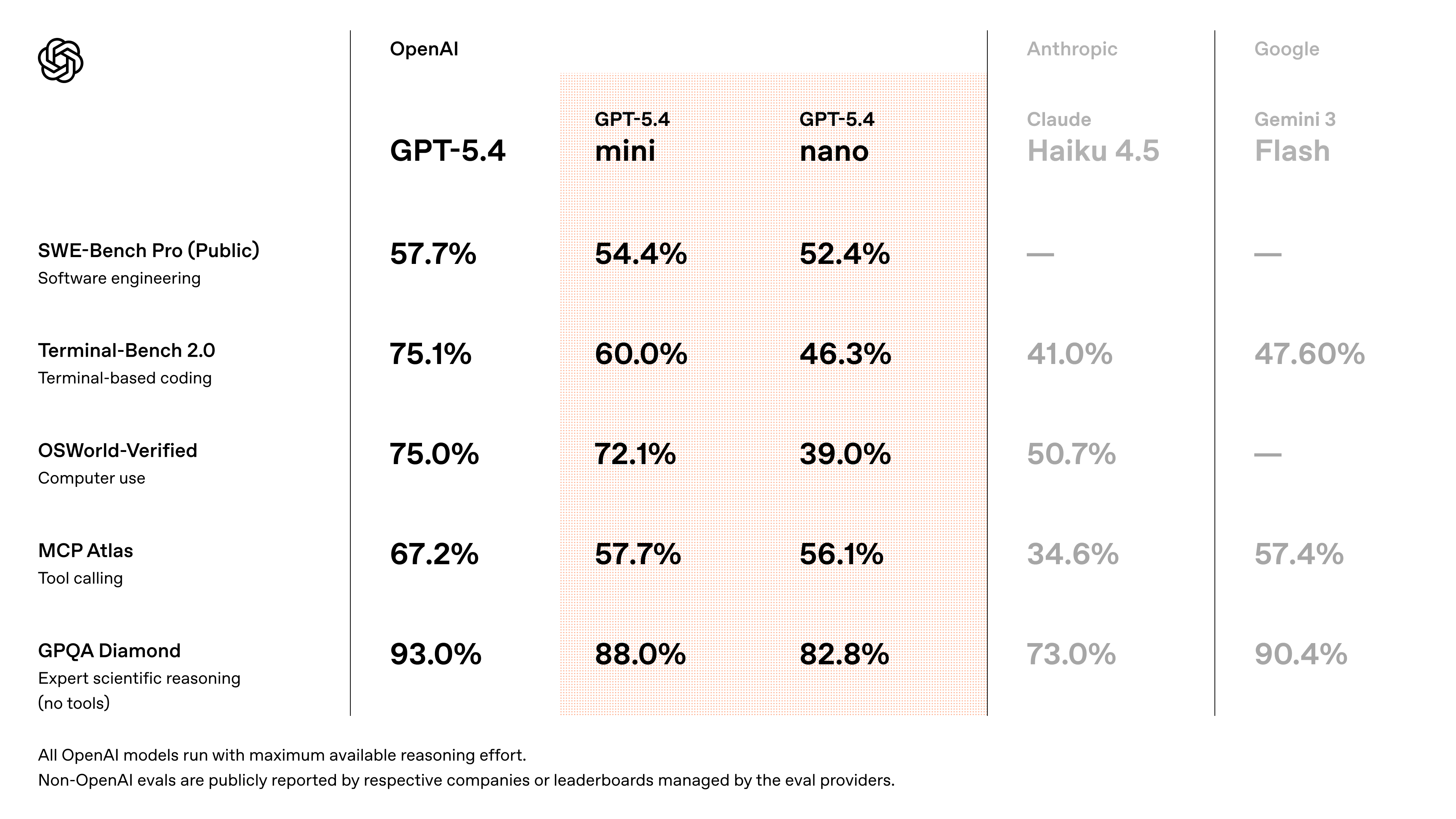
We pulled the benchmarks from OpenAI's announcement post. The gaps between Mini and Nano are smaller than you might expect on most tasks, except for computer use where Nano drops off a cliff.
Source: OpenAI announcement
| Benchmark | GPT-5.4 | Mini | Nano |
|---|---|---|---|
| SWE-Bench Pro | 57.7% | 54.4% | 52.4% |
| GPQA Diamond | 93.0% | 88.0% | 82.8% |
| OSWorld-Verified | 75.0% | 72.1% | 39.0% |
| Terminal-Bench 2.0 | 75.1% | 60.0% | 46.3% |
| MCP Atlas | 67.2% | 57.7% | 56.1% |
| tau2-bench (telecom) | 98.9% | 93.4% | 92.5% |
| HLE w/ tools | 52.1% | 41.5% | 37.7% |
| MMMUPro w/ Python | 81.5% | 78.0% | 69.5% |
The standout number: Mini hits 72.1% on OSWorld-Verified while Nano drops to 39.0%. That gap is enormous. If you need a model that can operate a browser or desktop, Mini is the only real option between these two. Nano wasn't designed for that.
On everything else, Nano stays surprisingly close. Tool calling (MCP Atlas: 56.1% vs 57.7%), telecom automation (92.5% vs 93.4%), and even coding (52.4% vs 54.4% on SWE-Bench Pro). For tasks that don't require computer use, Nano gives you roughly 95% of Mini's capability at 27% of the price.
How they stack up against the competition
The small model tier got competitive in early 2026. Google's Gemini 2.5 Flash-Lite is aggressively cheap. Claude Haiku 4.5 is more expensive than GPT-5.4 Mini. DeepSeek V3.2 sits in an odd middle ground. Here's the full picture.
| Model | Input / 1M | Output / 1M | Cached / 1M | Context |
|---|---|---|---|---|
| GPT-5.4 Mini | $0.75 | $4.50 | $0.075 | 400K |
| GPT-5.4 Nano | $0.20 | $1.25 | $0.02 | 400K |
| Claude Haiku 4.5 | $1.00 | $5.00 | $0.10 | 200K |
| Gemini 2.5 Flash-Lite | $0.10 | $0.40 | $0.01 | 1M |
| DeepSeek V3.2 | $0.28 | $0.42 | $0.028 | 128K |
| Mistral Small 3.2 | $0.10 | $0.30 | - | 128K |
If price is all you care about, Gemini 2.5 Flash-Lite and Mistral Small 3.2 are both cheaper than GPT-5.4 Nano on input, and dramatically cheaper on output. Gemini Flash-Lite at $0.40 output vs Nano's $1.25 is a 3x difference.
But price alone doesn't tell you much. GPT-5.4 Mini scores 88.0% on GPQA Diamond. Gemini Flash-Lite isn't competing at that level. If you need reasoning quality at a mid-tier price, Mini is hard to beat. If you need raw volume at the lowest cost, Gemini and Mistral win. You can compare all of these on our pricing page.
What this costs in practice
We ran four common workloads through the TokenCost calculator to see how Mini and Nano compare in monthly spend. Standard API pricing, no caching or batch discounts applied.
With prompt caching enabled, these numbers drop by up to 90% on the input side. If you're sending the same system prompt repeatedly, that changes the math entirely.
When to pick Mini vs Nano
This is simpler than it looks. The decision mostly comes down to whether you need the model to interact with external tools and screens, or just process text.
- Agentic workflows with computer use
- Code generation and code review
- Complex tool calling chains
- Tasks where you'd otherwise use GPT-5.4
- ChatGPT Free/Go users (it's the default fallback)
- Classification and data extraction
- Query routing and intent detection
- High-volume, low-complexity tasks
- Subagent calls inside a bigger pipeline
- Anywhere you used GPT-5 nano before
One thing we noticed: for tool calling that doesn't involve computer use, Nano is surprisingly close to Mini on MCP Atlas (56.1% vs 57.7%). If your agent calls APIs but doesn't need to click around a desktop, Nano saves you 73% on input costs with barely any quality loss.
Speed matters more than you think
OpenAI says both models are "more than 2x faster" than GPT-5 mini. Community measurements suggest Mini runs around 180-190 tokens per second, Nano around 200 tok/s. GPT-5 mini sat at 55-60 tok/s.
For single requests, that difference is a few hundred milliseconds. But in agent pipelines where you chain 5-10 model calls per task, the speed compounds fast. A pipeline that took 30 seconds on GPT-5 mini might finish in 10 seconds on Mini. That's the kind of improvement that changes what you can build in real-time applications. In OpenAI's Codex product, Mini burns only 30% of the GPT-5.4 compute quota, so you can run more parallel tasks before hitting limits.
Bottom line
GPT-5.4 Mini is the better model. GPT-5.4 Nano is the better deal. That's really it.
Mini at $0.75 per million input tokens gives you computer use, strong coding benchmarks, and near-flagship reasoning at 70% less than GPT-5.4. It's cheaper than Claude Haiku 4.5 ($1.00) and gets more done. If you're building agents that need to interact with software, this is the obvious pick.
Nano at $0.20 per million is for volume. Classification, extraction, routing. It scores within a few points of Mini on most text-based benchmarks while costing 73% less. With batch pricing, you're down to $0.10 per million input. With caching on top of that, $0.01.
Run the numbers for your specific workload with the cost calculator, or compare these against every other model on our pricing page.
Sources
- OpenAI: Introducing GPT-5.4 mini and nano (March 17, 2026)
- OpenAI API Pricing (retrieved March 23, 2026)
- OpenAI API Docs: GPT-5.4 mini model card
- OpenAI API Docs: GPT-5.4 nano model card
- The Decoder: GPT-5.4 mini and nano analysis (March 17, 2026)
- Anthropic: Claude API pricing
- Google: Gemini API pricing