
Sakana priced Fugu Max at $2 and $6, which is Qwen3.8 Max's card to the cent, and says the output line is 40% to 60% under Sonnet 5, Terra and Kimi K3. The tokens billed at that rate include every internal call the orchestrator makes, and Sakana publishes neither the count nor the models it calls.
Fugu Max went on sale yesterday, September 11, as a new line on Sakana AI's console: $2.00 per million input tokens, $6.00 output, $0.25 cached, flat to a million tokens of context. Sakana calls it a cost-performance model and the launch post backs that with a chart of ten benchmarks plotted against output price, where a red Fugu Max dot sits above a dashed frontier of single models. The output number checks out against the three cards Sakana names. What the chart cannot show is the thing that makes this model different from every other dot on it. Fugu is an orchestrator, a model trained to call other models and copies of itself, and Sakana bills the tokens those internal calls consume at the same $2 and $6. It reports them in their own usage fields, it says in writing that they are counted in the price, and it does not say, anywhere, how many of them a request tends to produce. So we worked out how many it can afford to produce before the 40% to 60% is gone. On an ordinary coding-agent turn the answer is 11.1%.
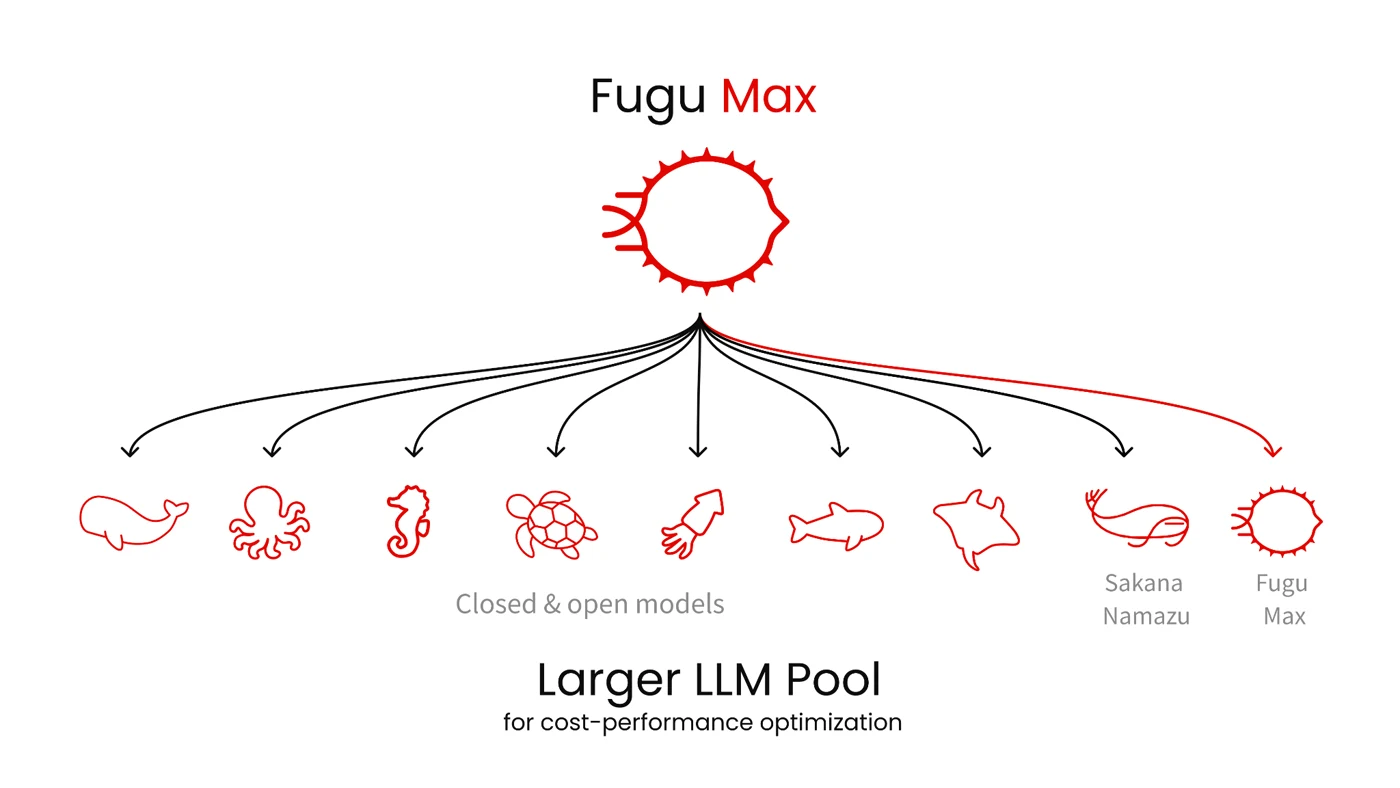
Image source: Sakana AI
Fugu Max, per million tokens
$2.00 / $6.00 / $0.25
Input, output, cached input. Flat to 1M context. Identical to Qwen3.8 Max on all three lines, and to GPT-5.6 Terra's batch output.
Orchestration overhead that erases the saving
11.1% vs Sonnet 5
On a 30,000-in, 2,000-out agent turn. 16.7% erases the gap to Terra, 66.7% the gap to Kimi K3. Sakana publishes no figure for the overhead.
One new line on a card that has not moved since June
The launch post is titled "Introducing Fugu Max and Fugu Ultra v2: Orchestrating the Pareto Frontier," which reads like two pricing events. It is one. Here is the whole pay-as-you-go card as it stood on console.sakana.ai on September 12, with the date each line first appeared.
| Model | Input | Output | Cached | Over 272K | Since |
|---|---|---|---|---|---|
| Fugu Max (fugu-max-v1.0) | $2.00 | $6.00 | $0.25 | No tier | Sep 11, 2026 |
| Fugu Ultra (fugu-ultra-v2.0) | $5.00 | $30.00 | $0.50 | $10 / $45 / $1.00 | Jun 22, 2026 (v1.0) |
| Fugu (base) | Rate of the top-tier model in your pool; "we never stack model fees" | Jun 22, 2026 | |||
| Fugu Cyber | Contact sales. Was $6.00 / $36.00 / $0.60 in a July 28 snapshot | Jul 2026 | |||
| web_search, web_fetch | $0.007 per call on Sakana; $0.01 per call on OpenRouter | - | |||
We checked the Ultra line against four Wayback captures of sakana.ai/fugu. The June 22 capture, taken on launch day at 01:58 UTC, reads "Fixed pricing for fugu-ultra-20260615" with $5, $30 and $0.50 and the same $10, $45 and $1.00 above 272K. The July 24 v1.1 post says "the same price as Fugu-Ultra v1.0." The September 10 capture, taken at 18:16 UTC the evening before launch, still shows that block and no Max. Three versions, one card. If you were paying for Ultra on Thursday you are paying the same on Friday, for a model Sakana says scores best or joint-best on five of eight benchmarks without Fable 5, Fable 5.1 or GPT-6 Astra in its pool. That is a capability story and we will leave it to people who run benchmarks. The pricing story is the second row.
Two things on that row before the numbers. The model id fugu-max resolves to fugu-max-v1.0 today and will resolve to whatever Sakana ships next; the console lists both, so pin the versioned one if the pool matters to you. And "regardless of context length" is Sakana's phrase, not ours. Ultra doubles its input and cached rates and adds 50% to output past 272,000 tokens, the same threshold and the same multipliers OpenAI uses on GPT-5.6, which is not a coincidence worth pretending is one. Max has no such row.
What an output token is on this model
Sakana describes Fugu as "a language model trained to call various LLMs in an agent pool, including instances of itself recursively." A request goes to the orchestrator, the orchestrator decides which models in its pool to call and in what order, those models produce tokens, and the orchestrator assembles a final answer. The technical report says the Ultra variant is trained to "design agentic workflows of up to 5 steps." Every one of those steps reads tokens and writes tokens. The question for a pricing site is who pays for them, and the pricing page answers it in one paragraph, which we quote in full because the wording is doing a lot of work:
"Outside of standard Responses API output, Fugu Ultra returns usage fields that separate user-visible model work from orchestration work. Note that unlike OpenAI, even though the orchestration tokens are stored in token_details fields, they represent real token usage outside of the input and output tokens and will be counted in the final price of the request. The price will be the same as standard input and output tokens."
"Unlike OpenAI" is the important clause. On an OpenAI response, output_tokens_details.reasoning_tokens is a breakdown of output_tokens: the reasoning is already inside the number you multiply by the rate. On a Fugu response, orchestration_input_tokens, orchestration_input_cached_tokens and orchestration_output_tokens sit in the details objects but are additive. The page defines total_tokens as the count "including orchestration," and its own example shows input 120, output 80, total 200 with every orchestration field at zero, so total is the sum of all five. Any cost tracker that does what cost trackers do, read input_tokens and output_tokens and multiply by the card, will under-report a Fugu bill by exactly the orchestration share. LiteLLM's pricing file, which most of those trackers use, has no Sakana entry at all as of this morning, so the more likely failure is that the request is not priced at all.
The paragraph names Fugu Ultra, and the models page names Ultra and Cyber. Fugu Max is not named on either. We do not read that as an exemption. The description Sakana supplied to OpenRouter for fugu-max says "Orchestration tokens consumed by the system are billed as standard input/output tokens," word for word the same sentence as on fugu-ultra-v2, and the product FAQ says routing for every Fugu tier is "not exposed by design." We asked nobody at Sakana, because this is a pricing page and the pricing page is the source; if a later revision says Max is exempt we will say so here.
What the page does not say is the size of the share, and here Sakana's own documentation for a different product is the most useful thing on the site. Sakana Namazu, its Japanese model, ships with web search and code execution, and its pricing page explains what happens inside a single request when tools run: "Each internal call re-sends the full prompt, including the conversation history and all tool results so far," and "The input token count in the response's usage object is the total across all internal calls." That is the mechanism. It is how every agent loop bills, on every provider, and it is why an orchestrator that runs a five-step workflow over a 50,000-token coding context can send 250,000 input tokens to answer one turn. Whether those re-sends land at $2.00 or $0.25 depends on how much of the prefix the cache catches between internal calls, and Sakana has a field for that too. It just has no number.
To be fair to Sakana about what it does disclose: it reports the orchestration tokens per request, which is more than a plain reasoning model tells you about its thinking, and its FAQ says you can "monitor spend in real time and forecast costs before scaling up." Both true. Neither helps you before the first request, and the launch post's cost bullet, "40-60% lower than Sonnet 5, GPT 5.6 Terra, and Kimi K3," is a claim about the first request.
Where the 40% to 60% survives
Since the overhead is unpublished, the honest thing is to compute the overhead at which Fugu Max stops being cheaper, and let the reader decide whether an orchestrator that calls up to five models is likely to come in under it. We define overhead as orchestration tokens divided by visible tokens, applied to input and output alike, and price two prompt shapes on the September 12 cards: a coding-agent turn at 30,000 input and 2,000 output tokens, and a long answer at 1,000 input and 5,000 output.
| Compared with | Card | Agent turn, 30K / 2K | Long answer, 1K / 5K | Break-even overhead |
|---|---|---|---|---|
| Fugu Max, zero orchestration | $2 / $6 | $0.0720 | $0.0320 | - |
| Qwen3.8 Max | $2 / $6 | $0.0720 | $0.0320 | 0% on both |
| Claude Sonnet 5 | $2 / $10 | $0.0800 | $0.0520 | 11.1% / 62.5% |
| GPT-5.6 Terra | $2 / $12 | $0.0840 | $0.0620 | 16.7% / 93.8% |
| Kimi K3 | $3 / $15 | $0.1200 | $0.0780 | 66.7% / 143.8% |
| Gemini 3.8 Flash, to Dec 31 | $0.75 / $3.75 | $0.0300 | $0.0195 | Never; Fugu costs 2.40x / 1.64x as much at zero |
| GLM-5.3 | $1.40 / $4.40 | $0.0508 | $0.0234 | Never; 1.42x / 1.37x dearer at zero |
Read the Sonnet 5 row first, because Sonnet 5 is the model Sakana leads with. On the long answer, Fugu Max's output discount is worth a lot: it can spend 62.5% more tokens than it shows you and still tie. On the agent turn, the prompt shape most people buying a coding orchestrator actually have, the margin is 11.1%. That is because the agent turn is 94% input tokens, and on input Fugu Max has no discount at all: $2.00 is what Anthropic charges for Sonnet 5 and what OpenAI charges for Terra. The entire saving on a 30,000-token turn is the $4 per million on 2,000 output tokens, which is eight tenths of a cent. One internal re-send of the prompt, uncached, costs six cents.
Our assumption that overhead lands on input and output in equal proportion is generous to Fugu. If the orchestration is mostly re-sent context, which is what Sakana's Namazu page says an internal loop does, the overhead concentrates on the line where Fugu Max is level with its rivals rather than the line where it is cheaper, and the break-even on the agent turn falls below 11.1%. If it lands at $0.25 because the cache catches the prefix, it rises. Sakana has the field that would settle this. It has not printed a value for it.
One 30,000-input, 2,000-output agent turn, priced on September 12 cards. Fugu Max shown at four orchestration overheads.
- Gemini 3.8 Flash
- $0.0300
- Sonnet 5, batch
- $0.0400
- GLM-5.3
- $0.0508
- Fugu Max, 0% overhead
- $0.0720
- Sonnet 5
- $0.0800
- GPT-5.6 Terra
- $0.0840
- Fugu Max, 25% overhead
- $0.0900
- Fugu Max, 50% overhead
- $0.1080
- Kimi K3
- $0.1200
- Fugu Max, 100% overhead
- $0.1440
Highlighted bars are the same request at different, and unknown, orchestration shares. Sonnet 5 sits between the first two of them. Kimi K3, the model that gives Sakana its 60% headline, is passed at 66.7%.
And then the first row of the table, which we think is the strangest fact about this launch. Qwen3.8 Max sells for $2.00 input, $6.00 output and $0.25 cached input on OpenRouter and on Vercel's AI Gateway. Fugu Max is priced to the cent on all three lines. Qwen3.8 Max is a single model. It is also one of the eight dots on Sakana's own chart, sitting at the same $6 on every panel, where it beats Fugu Max on CharXiv, 88.4 to 88.1, and loses on the other nine. So on the day it launched, the claim "Fugu Max expands the Pareto frontier" had a precise meaning: at a rate card Alibaba already sells, Sakana says it scores higher, and at that rate card a single orchestration token makes Sakana the dearer of the two.
The x-axis is not today's prices
Sakana's launch chart plots ten benchmarks against "Output price (USD per 1M tokens; lower is better)," with a dashed line through the single-model frontier and Fugu Max in red. The post says Fugu Max "expands the cost-performance Pareto frontier on seven out of ten benchmarks." The scores are Sakana's and we cannot check them. The prices are public and we can.
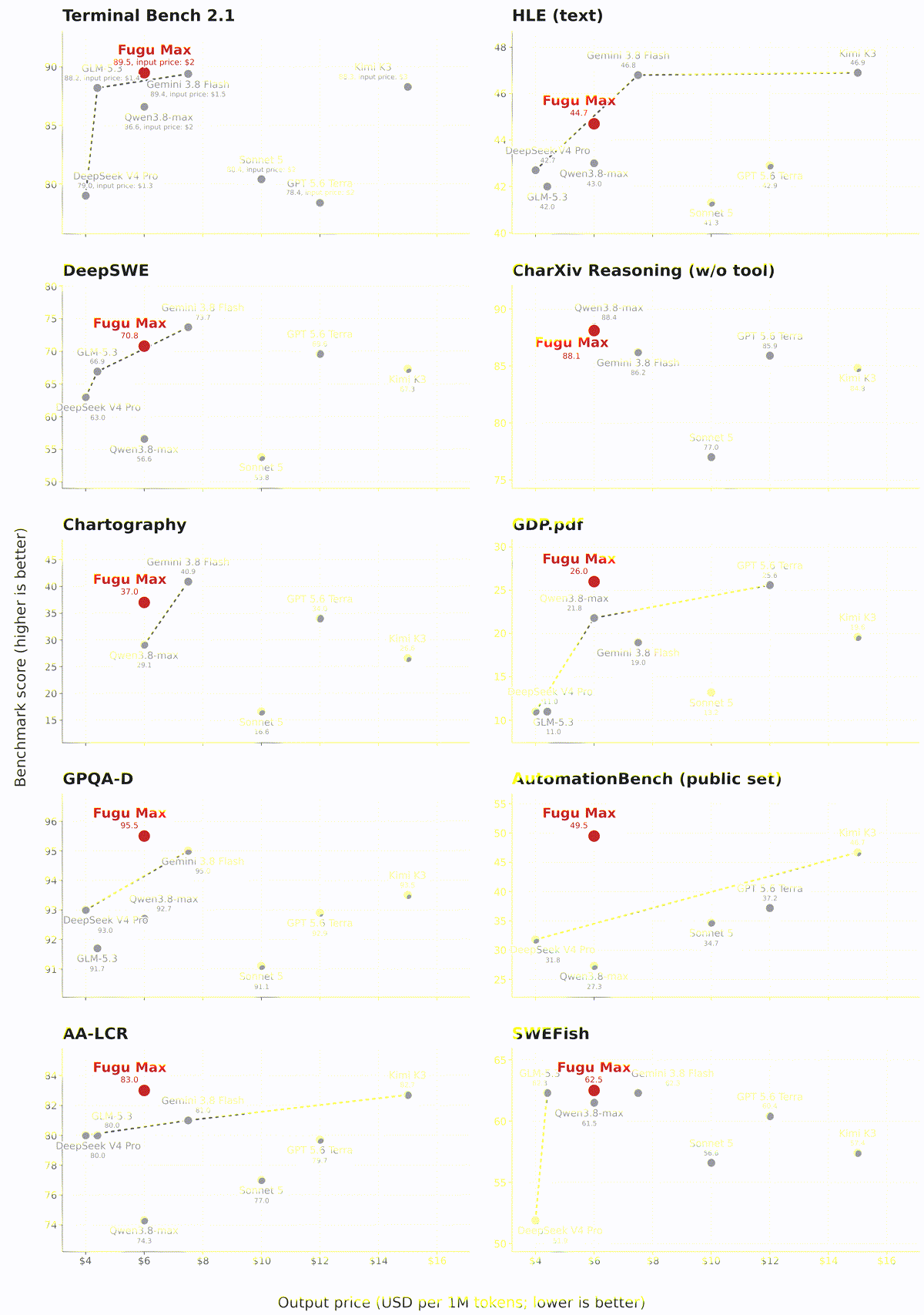
Chart source: Sakana AI. Gemini 3.8 Flash is plotted at about $7.50 output on the nine panels it appears on; DeepSeek V4 Pro at about $4.00.
Gemini 3.8 Flash is on the chart at roughly $7.50 output, and the Terminal Bench panel, the only one that also prints input prices, labels it "input price: $1.5." Those are real numbers. They are Google's numbers for January 1, 2027. Google's pricing page lists Gemini 3.8 Flash at $0.75 input and $3.75 output "through December 31, 2026," with $1.50 and $7.50 taking over after, and it has said so since the model launched on September 2. Every request anyone sends to Gemini 3.8 Flash for the next 110 days bills at half the price Sakana drew. We wrote about that introductory window when it opened, and the short version is that it is Google's current price with a published end date, not a discount off a list price that exists today.
Move the Gemini dot to $3.75 and it lands left of every other model on the chart, DeepSeek included, so the single-model frontier at $6 is at least Gemini's score on every panel it appears on. Recount: Fugu Max still clears the frontier on Terminal Bench 2.1 (89.5 to Gemini's 89.4), GPQA-D (95.5 to 95.0), SWEFish (62.5 to 62.3), AA-LCR (83.0 to 81.0), GDP.pdf (26.0 to 19.0) and AutomationBench, where Gemini is not plotted. It no longer clears it on DeepSWE (70.8 to 73.7), Chartography (37.0 to 40.9) or HLE (44.7 to 46.8), and it never did on CharXiv, where Qwen3.8 Max is ahead at the same price. Six of ten, not seven, and three of the six are by half a point or less. At $0.75 and $3.75 Gemini 3.8 Flash comes in at $0.030 on our agent turn against Fugu Max's $0.072, 42 cents on the dollar before Sakana bills a single orchestration token, and Artificial Analysis clocks it at 268.5 tokens per second against the 38 OpenRouter measured for Fugu Max at 08:15 UTC today.
DeepSeek V4 Pro is the other dot drawn at a price it rarely charges. Sakana plots it at $1.30 input and about $4.00 output, which is DeepSeek's peak rate, $1.32 and $3.96. Peak runs seven hours a weekday. The other 133 hours of the week the same model bills $0.66 and $1.98, and the chart already had DeepSeek at the far left, so the placement changes no conclusion about Fugu. It is worth a paragraph for a different reason. When Sakana published the chart on Thursday morning, DeepSeek's pricing page said that from September 14 every deepseek-v4-pro request would be routed to V4.1 Flash and billed at $0.15 and $0.60, which we wrote up on Wednesday. Sometime between 07:47 and 16:55 UTC on Thursday, per two Wayback captures, footnote 2 on that page was rewritten: "In response to user demand, we have decided to continue providing API services for DeepSeek V4 Pro after September 14, 2026, with the billing method remaining unchanged." So the dot on Sakana's chart spent part of launch day pointing at a model with 72 hours to live and the rest of it pointing at one that will keep its card. We have corrected Wednesday's post and removed the September 14 price change from our own catalogue. DeepSeek's news page still carries the routing announcement; the pricing page is the one that bills you.
The columns the chart leaves out
A single output price per model is a fair way to draw a chart and an incomplete way to price a workload. Three columns are missing, and each one moves a comparison.
| Model | Batch | Cache read | Long context | Hidden tokens |
|---|---|---|---|---|
| Fugu Max | None published | $0.25 (12.5% of input) | Flat to 1M | Orchestration in and out, billed, count unpublished |
| Claude Sonnet 5 | $1 / $5 | $0.20 (10%) | Flat to 1M | Thinking, inside output_tokens |
| GPT-5.6 Terra | $1 / $6 | $0.20 (10%) | 2x input, 1.5x output over 272K | Reasoning, inside output_tokens |
| Kimi K3 | None | $0.30 (10%) | Flat to 1M | Always reasons, inside output_tokens |
| Fugu Ultra v2 | None published | $0.50 (10%) | 2x input, 1.5x output over 272K | Orchestration in and out, billed, count unpublished |
Batch is the one that hurts. Anthropic sells Sonnet 5 at $1 and $5 through the batch API; OpenAI sells Terra at $1 and $6. Both of those are below Fugu Max's standard card on input, and Terra's batch output is Fugu Max's standard output to the cent. For the offline evaluation and bulk-processing work that a "cost-performance" model is presumably for, Sonnet 5 in batch costs $0.040 on our agent turn against Fugu Max's $0.072 before orchestration. Sakana publishes no batch rate, and given that the product is a live orchestrator dispatching to other providers, we would not expect one.
The cache column is a small point in Fugu's favour that is not on the chart either: $0.25 is 12.5% of input, against the 10% every other model here charges, so Fugu Max's cache discount is slightly shallower, but Anthropic also bills a cache write at 1.25x input and Sakana's page mentions no write charge. And the long-context column is where "regardless of context length" earns its place: of the three models Sakana names, only Terra has a cliff. Sonnet 5 and Kimi K3 are flat to a million tokens too, so the flat card is a genuine edge over exactly one of the three, on prompts above 272,000 tokens, where it is also the shape of prompt an orchestrator re-sends most expensively.
One more line item, for people building search into Fugu Max. The tools are $0.007 per call on Sakana's page and $0.01 per call on OpenRouter's listing for the same model. And the models page adds a sentence about the open-weights pool that belongs next to the rate: "Because we use open-source models without native web search support, these models use our internal web tools. Each internal tool call costs $0.007, and a single query may require multiple calls to produce a complete answer." Same structure as the tokens. A per-unit rate, a unit the orchestrator decides how many of to consume, and no typical count.
What is in the pool, and what is measuring it
Sakana says Fugu Max works by "integrating an unprecedented number of open-weights and specialized models, including NVIDIA's Nemotron family." The diagram at the top of this post, which is Sakana's, labels the row of creatures it routes to "Closed & open models," plus Sakana Namazu and a second Fugu Max. So the pool contains closed models, the text does not say which, and the FAQ says it will not: "The specific models Fugu selects and how it coordinates them are proprietary, so this routing information is not exposed by design." The June technical report said the Ultra v1 pool included Gemini 3.1 Pro, Claude Opus 4.8 and GPT-5.5. The v2 post names only three models that are not in the pool. Between those two disclosures, the pool went from published to described by its exclusions, and Fugu Max, being the cheaper tier, is the one you would most want to know the composition of.
That matters for price because the base Fugu tier bills at "the standard rate for the specific underlying model," and when several are active, "a single rate based on the top tier model involved." Max and Ultra replace that with a fixed card. A fixed card on a pool whose top-tier member is unnamed is a bet that Sakana's routing keeps the expensive member idle often enough for $6 to cover it. Sakana's FAQ also says it expects "roughly two weeks" to fold a new frontier model into Fugu after release, which is a promise that the pool changes under a fixed price. That can go either way for the buyer and nothing on the card tells you which.
On measurement: every Fugu Max score in this post is Sakana's. Artificial Analysis lists no Sakana model, and its model page for fugu-max returns a 404, which is a slightly odd state of affairs for a launch chart whose ninth panel is AA-LCR, an Artificial Analysis benchmark. The v1 report said baseline scores were provider-reported; the Max chart does not say. The independent numbers that exist are throughput. OpenRouter showed Fugu Max at 72 tokens per second median with 8.39 seconds to first token this morning, and Ultra v2 at 55 and 5.77. DataNorth, writing hours after launch, read 13 tokens per second and 5.37 seconds off the same page. Both are one provider's day-one traffic and we would weight neither heavily, except to say that nothing about a five-step orchestrator suggests the latency is a launch-day artefact.
Two footnotes on who can buy it. Fugu is not sold in the EU or EEA, which Sakana states in its FAQ and terms. And the Hacker News thread for this launch had 5 points and no comments at the time of writing, against 247 points and 127 comments for the June general-availability thread, where one user wrote that "For $200/month you get < 3 hours of use per week" and another described "paying ~$60 to get a hit-or-miss report" on pay-as-you-go. Those are June numbers on a card that has not changed since. Fugu Max is the first Fugu built to answer them, and the answer is a card with an unpublished multiplier on it.
For our part, Sakana AI is a new provider in our pricing table as of today, with fugu-max at $2.00 and $6.00 and fugu-ultra-v2.0 at $5.00 and $30.00, both with the September 12 console page as the source. The notes on each entry carry the orchestration billing rule in Sakana's words, the cache and long-context lines, the OpenRouter throughput readings, and the absence of an Artificial Analysis score. We have not added the base Fugu tier, because a model whose price is "whichever model it picked" cannot be put on a per-million-token row honestly, and we have not added Cyber, which has no public price. The calculator prices Fugu Max on visible tokens only, which is the same limitation this post is about, so treat its figure as the floor.
Sources, and the two numbers Sakana does not print
Two figures in this post are absent from every Sakana page we read: the typical share of a request that is orchestration tokens, and the list of models in the Fugu Max pool. Everything else below is quoted from the page named, read on September 12.
- Sakana AI: console pricing - The Fugu Max card at $2, $6 and $0.25 "regardless of context length," the Fugu Ultra card at $5, $30 and $0.50 with $10, $45 and $1.00 above 272K, the base Fugu "never stack model fees" rule, web_search and web_fetch at $0.007 per call, the "Usage field details" paragraph on orchestration tokens being "counted in the final price of the request," the field definitions, the $20, $100 and $200 subscriptions, and the Sakana Namazu section on how an agent loop re-sends the full prompt on each internal call
- Sakana AI: Introducing Fugu Max and Fugu Ultra v2 - The September 11 launch post. Source for the "40-60% lower than Sonnet 5, GPT 5.6 Terra, and Kimi K3" claim, "seven out of ten benchmarks," the "integrating an unprecedented number of open-weights and specialized models, including NVIDIA's Nemotron family" description, the note that Fable 5, Fable 5.1 and GPT-6 Astra are not in Ultra v2's pool, the August 28 training cutoff, and the ten-panel scatter chart and pool diagram reproduced above
- Sakana AI: console models - Model ids fugu-max and fugu-max-v1.0, fugu-ultra defaulting to v2.0, the statement that Ultra and Max use fixed pools, the orchestration usage paragraph scoped to "Fugu Ultra and Fugu Cyber," the max_output_tokens note that the orchestrator keeps its own limit, and the internal web tools sentence that "a single query may require multiple calls"
- Sakana AI: Fugu product page and FAQ - FAQ Q4 on "roughly two weeks" to add a new frontier model, Q5 restating the card, Q6 on the blended base-tier rate, Q7 on per-request cost reporting, Q9 that routing is "not exposed by design," and Q10 that the service is not offered in the EU or EEA
- Wayback Machine: sakana.ai/fugu, June 22, 2026 - "Fixed pricing for fugu-ultra-20260615" at $5, $30 and $0.50 with $10, $45 and $1.00 above 272K. Later captures on July 28 (Fugu Cyber at $6, $36 and $0.60), August 24 (Cyber moved to contact sales) and September 10 at 18:16 UTC (no Fugu Max) were read the same way
- Sakana AI: Fugu-Ultra v1.1 - The July 24 post stating v1.1 is "available today at the same price as Fugu-Ultra v1.0"
- Sakana AI: Fugu general availability - The June 22 post describing Fugu as "a language model trained to call various LLMs in an agent pool, including instances of itself recursively," and the note that baseline scores in that release were provider-reported
- Sakana AI: Fugu technical report - Ultra "instructed to design agentic workflows of up to 5 steps" over a pool that at v1 included Gemini 3.1 Pro, Claude Opus 4.8 and GPT-5.5
- OpenRouter: sakana/fugu-max - Listed 05:32 UTC on September 11 at $2, $6 and $0.25 with web search at $0.01 per call, 1M context, 128K max output, the Sakana-supplied description that "Orchestration tokens consumed by the system are billed as standard input/output tokens," and the throughput readings of 72 tokens per second and 8.39 seconds on six requests at 07:48 UTC September 12, then 38 tokens per second and 2.78 seconds on 23 requests at 08:15 UTC; sakana/fugu-ultra-v2 listed 05:43 UTC September 11, reading 51.5 tokens per second and 7.14 seconds on 66 requests at 08:15 UTC
- Anthropic: Claude pricing - Sonnet 5 at $2 and $10 as the standard price, $0.20 cache read, $1 and $5 batch, full 1M context with no long-context surcharge
- OpenAI: API pricing - GPT-5.6 Terra at $2, $0.20 cached and $12, $1 and $6 in batch, and $4 and $18 above 272K input tokens
- Moonshot: Kimi pricing - Kimi K3 at $3.00 cache miss, $0.30 cache hit and $15.00 output, 1,048,576 context billed flat
- Google: Gemini API pricing - Gemini 3.8 Flash at $0.75 and $3.75 "through December 31, 2026" and $1.50 and $7.50 from January 1, 2027
- DeepSeek: pricing - V4 Pro at $0.66 and $1.98 off-peak and $1.32 and $3.96 during the weekday peak windows. Footnote 2 read "requests to deepseek-v4-pro will all be routed to V4.1 Flash and billed at the V4.1 Flash price" in Wayback captures through 07:47 UTC on September 11 and "we have decided to continue providing API services for DeepSeek V4 Pro after September 14, 2026, with the billing method remaining unchanged" from the 16:55 UTC capture onward
- Artificial Analysis: models - No Sakana entry on the models page as of September 12; /models/fugu-max and /providers/sakana return 404. Gemini 3.8 Flash at 268.5 median output tokens per second at 08:15 UTC
- DataNorth: Sakana AI launches Fugu Max and Fugu Ultra v2 - The 13 tokens per second and 5.37 second OpenRouter reading taken hours after launch
- Hacker News: Fugu Max and Fugu Ultra v2 - 5 points and no comments at the time of writing. The June 22 thread had 247 points and 127 comments, including the "< 3 hours of use per week" and "paying ~$60 to get a hit-or-miss report" remarks